Halloween Gifts for Book Lovers: A Reader-First Guide
Share
The best Halloween gift for a book lover is not automatically a spooky novel. Give a specific title only when you can confirm the reader’s taste, preferred format, exact edition, and whether they already own it. When any of those details is uncertain, preserve their choice or improve a reading habit you have actually observed. Halloween can live in the story, the reading moment, or simply the presentation.
Start with the evidence you have, not a generic image of a “bookworm.” Some readers collect hardcovers; others borrow paperbacks, annotate inexpensive copies, read ebooks, or listen to audiobooks. The right gift supports their version of reading at a level of spookiness they genuinely enjoy.
Start with four signals from the reader
Before choosing an item, separate what you know from what you are filling in yourself. Four signals determine whether a book, accessory, experience, or flexible choice is the stronger gift.
- Story fit: Which genres, authors, series, and emotional tones does the reader choose? “Likes Halloween” does not reveal whether they prefer playful ghosts, gothic suspense, graphic horror, cozy mystery, dark fantasy, or no frightening fiction at all.
- Access fit: Do they read print, ebooks, audiobooks, or a mix? For a specific work, do you know the desired edition, translation, illustration, narration, and condition?
- Ritual fit: Where and how do they read? Notice whether they annotate, commute, read in bed, borrow from the library, collect display editions, protect dust jackets, or avoid accumulating objects.
- Gesture fit: How personal, expensive, permanent, or Halloween-specific should the gift be for this relationship? A close partner’s requested collector edition and a casual coworker’s seasonal token require different confidence levels.
A clear request is usually more useful than an ingenious guess. If the reader has named a title, shared a wish list, or pointed out a specific edition, use that clue. If all you know is that they enjoy books, keep the gift flexible and let a thoughtful note carry the personal meaning.
Choose the gift route that matches your confidence
The safest route changes with the specificity of your information. Use the table to choose a complete direction rather than collecting unrelated bookmarks, mugs, socks, and candy to make the package look larger.
| What you know | Best route | Complete gift direction | Check before buying |
|---|---|---|---|
| The exact title, edition, and format they want | Give the requested book | The precise copy, a note naming the clue you remembered, and Halloween wrapping that does not alter the book | Ownership, edition details, condition, and whether they welcome an inscription |
| A favorite work and clear collector behavior | Honor an established favorite | The special or alternate edition they have identified, presented as one complete gift | Exact version, authenticity, duplication, shelf space, and display preference |
| Their genre, but not the next title or current library | Preserve discovery | Flexible credit for the bookstore or digital service they use, plus a note such as “Choose your October mystery” | Store, service, region, format, and whether the genre signal is specific enough |
| They primarily read ebooks or listen to audiobooks | Support the digital routine | Credit within their existing ecosystem or an exact requested edition, delivered with a seasonal digital card | Platform, account, region, title ownership, narrator, device, and redemption terms |
| Their reading location and decorating taste | Improve one known part of the setting | One correctly sized reading-space object or décor accent, paired with a flexible book choice | Surface or shelf space, dimensions, controls, power needs, lighting purpose, and off-season storage |
| Only that they “like books” | Keep commitment low | A modest choice from a seller they use, a handwritten card, and removable Halloween presentation | Preferred seller, delivery region, relationship scale, and whether an outing would add pressure |
More knowledge permits more specificity; it does not require more items. One exact edition can be a complete gift. One flexible book choice with a well-written card can also be complete.
Give a book only when the details line up
A book is a high-confidence gift when the recipient has requested it or when you know their taste and library well enough to choose the exact work. Title alone is not always enough. Hardcover, paperback, large-print, ebook, and audiobook versions serve different reading habits, while a translation, illustrator, narrator, cover, or publication may be part of what the reader wants.
For a wish-list title, match the listing to a reliable identifier and compare the format, publisher, language, and cover. If the work has several translations or audio productions, confirm that detail too. Do not assume the newest, largest, signed-looking, or most ornate version is an upgrade.
A duplicate is useful only when it has a known role: perhaps the reader wants a lending copy, an annotation copy, or a named collector edition. Otherwise, preserve choice. Flexible store credit, a trip to browse together, or an invitation to select an October read avoids turning the recipient into the returns department.
Match a non-book gift to the way they read
Bookish merchandise is not automatically useful to a reader. Choose an accessory or reading-space object only when it solves an observed need or reflects a style the recipient already uses.
For print readers and annotators
Bookmarks, tabs, pencils, highlighters, reading journals, bookplates, stamps, and embossers all assume different relationships with books. A reader who writes in every paperback may appreciate supplies in their established format. A collector who keeps pages pristine may see the same kit as unusable.
Permanent personalization requires the strongest signal. Do not stamp, emboss, write in, or alter a book unless the recipient has welcomed that treatment. When uncertain, put the message on a separate card and make the Halloween details removable.
For ebook readers and audiobook listeners
Support the platform the recipient already uses rather than treating a digital habit as an invitation to choose new hardware. Confirm the service, region, account ecosystem, and current gifting method before purchasing credit or a title. For an audiobook, the narrator and production can matter as much as the written work.
A digital gift does not need physical filler to look generous. A specific note can explain the thought: “For the next long train ride,” “Choose a story for our October walk,” or “I remembered you wanted to try more gothic mysteries.”
For a known reading space
A bedside reader, commuter, café reader, and audiobook listener do not share one ideal setup. Before choosing a stand, sleeve, light, shelf accessory, or decorative object, confirm where it will go, how much space is available, and whether it matches the recipient’s usual style.
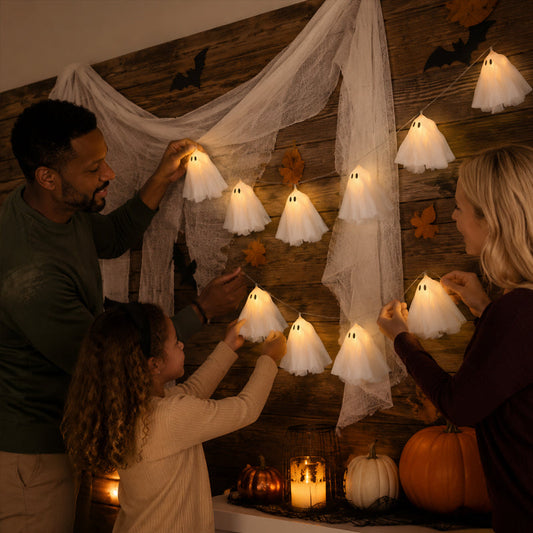
Keep ambient décor separate from equipment intended to illuminate a page. For a reader who enjoys friendly ghost décor and has a suitable shelf or tabletop, Niceovo’s Halloween Ghost Reading Lamp tabletop figurine is one seasonal décor direction. Check the current listing and the intended placement before ordering; do not assume a decorative glow will replace the reader’s task light.
Choose how much Halloween belongs in the gift
The reader’s preferred intensity matters more than the holiday label. Use the least intense level that still feels specific to them.
| Level | What it can look like | Choose it when | Skip it when |
|---|---|---|---|
| Presentation only | A ghost card, October reading invitation, or removable seasonal wrap around a year-round gift | They enjoy fall or the social side of Halloween but do not seek spooky stories or décor | The presentation would disguise an otherwise poor-fit item |
| Playful Halloween | Friendly ghosts, pumpkins, bats, or a light seasonal reading-space accent | Their existing taste is whimsical, cute, or classic rather than frightening | They avoid seasonal décor or have no space to store it |
| Genre-adjacent | Gothic fiction, cozy mystery, folklore, supernatural tales, or dark fantasy | You know the specific genre and emotional tone they enjoy | You are treating “reader” or “Halloween fan” as evidence of horror taste |
| Intense or franchise-specific | Graphic horror, disturbing imagery, a named character, or collector merchandise | The recipient has explicitly shown interest in that content or franchise | You are guessing from age, clothing style, or one unrelated favorite |
Mystery does not automatically mean murder, fantasy does not automatically mean gothic, and a love of October does not automatically mean a love of fear. If the emotional tone is uncertain, place Halloween in the card or wrapping and keep the gift itself within a known interest.
Use complete gift directions instead of filler
A focused Halloween gift has one clear purpose. Choose the direction that matches your evidence, then stop when the purpose is complete.
- The exact October read: Give the requested edition, an external note explaining the clue you remembered, and removable seasonal wrapping. Add nothing unless it supports a known habit.
- The discovery pass: Offer flexible credit for the reader’s usual bookstore or service, plus a short prompt such as “Choose the eerie, funny, or entirely unspooky story you want.” For a close relationship, offer a flexible browsing date.
- The annotation edition: Pair the exact reading copy they intend to mark with the tabs, pencil, or highlighters they already use. Do not substitute unfamiliar supplies merely because the colors look seasonal.
- The digital listening gift: Give credit or a requested recording in the recipient’s existing service, then tie the note to a real listening moment. Confirm that redemption will not create an unwanted continuing cost.
- The shelf moment: Choose one correctly sized décor accent for a reader whose space and Halloween style you know, then let them choose the book. The object supplies the seasonal theme; a pile of miniatures is unnecessary.
- The shared story: Plan a bookstore visit, library event, reading afternoon, or at-home discussion around a title the recipient helps select. Offer a real date range and an easy way to decline or reschedule.
Personalize without spoilers or permanent mistakes
Good personalization proves that you noticed the reader without taking control of their books. Refer to an established favorite, reading habit, or shared moment: “For your October mystery stack,” “For the next quiet Sunday,” or “I remembered how much you liked this author.”
Keep plot details out of the message unless you know the recipient has finished the work. A quotation, character image, adaptation design, or customized object can reveal an identity, relationship, death, or late-story change. When you cannot judge the spoiler risk, reference the reading experience rather than the plot.
Likewise, keep inscriptions outside the book unless the reader welcomes them. A loose card can remain with the gift without changing a collectible, exchangeable, or lendable copy.
Scale the cost and permanence to the relationship
Set the spending limit before browsing, then require stronger evidence as cost and permanence increase. A casual friend or coworker may suit a modest flexible choice, an observed-use accessory, or a bookstore invitation. A requested edition, device accessory, subscription, large décor piece, or permanently personalized item needs more confidence and a relationship that supports the gesture.
Do not use price or item count as a substitute for reader fit. Put the budget into the verified anchor instead of surrounding it with generic accessories. If a requested paperback and a thoughtful card solve the gift, a basket would only dilute the answer.
For shipped or personalized gifts, verify seller processing, the current delivery estimate, proof or approval steps, and the exact listing before purchase. Seasonal usefulness depends on arrival, but no single ordering cutoff fits every seller, format, or destination.
Run the final reader-fit check
- Do I know the reader’s genre and emotional tone, or am I preserving choice?
- If I am giving a work, is the format, edition, translation, or narration correct?
- Have I checked that they do not already own it, unless a duplicate has a known purpose?
- Does the gift suit how and where they actually read?
- Is the Halloween intensity theirs rather than mine?
- Does the price, permanence, and presentation fit our relationship?
If any answer depends on a guess, reduce the commitment: preserve title choice, use removable presentation, choose one modest observed-use item, or ask a discreet question. The most thoughtful Halloween gift for a book lover makes reading feel understood; it does not assign them a new genre, format, or shelf to manage.
Frequently asked questions
Should I buy a book if I do not know their favorite genre?
Usually, preserve the reader’s choice. Give flexible credit for the bookstore or digital service they already use, add a Halloween card, or invite them to browse with you. Choose a specific title only when you have a reliable clue about genre, format, and ownership.
What is a good non-book Halloween gift for a reader?
Choose something tied to an observed habit: the annotation supply they already use, compatible credit for an ebook or audiobook service, a correctly sized accessory, or a décor accent that matches their reading space. Avoid generic bookish merchandise when you cannot explain how they would use it.
Can a decorative reading lamp replace a task light?
Do not assume so. A decorative lamp can support the look of a reading nook without providing the coverage or controls the reader expects for a page. Verify the exact product details and treat ambient décor and functional reading illumination as separate needs unless the listing supports both.
How much should I spend on a Halloween gift for a book lover?
Use the relationship and your confidence in the choice to set the scale. A modest book choice or requested paperback can suit a casual relationship; expensive editions, devices, subscriptions, and permanent personalization require stronger evidence. Spending more does not correct a mismatch.